

Commercial opportunity · Launch preparation
From scientificprogramme tocommercial opportunity.
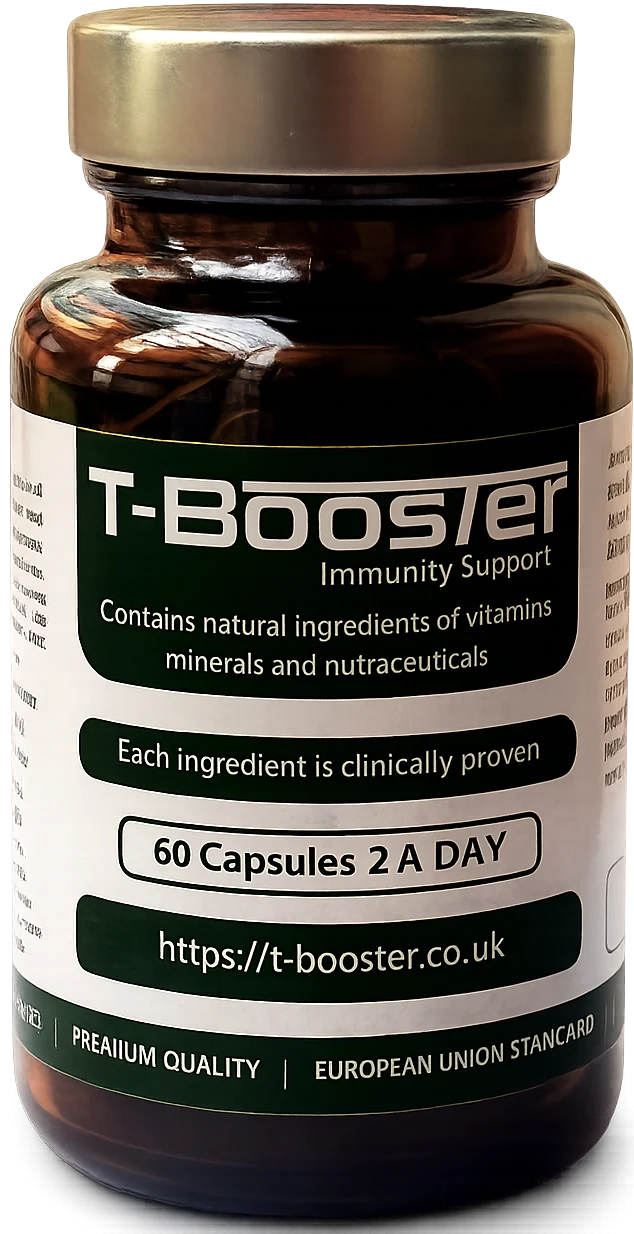
T-Booster brings together four years of R&D, an 18-ingredient formulation, UK GMP manufacturing and completed participation in two controlled human studies. The commercial phase now focuses on evidence completion, market preparation, channel access and disciplined validation before wider scale.
01 · Market context
A growing categorymakes room to focus.
2024 market size
US$86B
11.4%CAGR
US$46B forecast category expansion
2028 forecast
US$132B
Source cited in the investor deck: Stratview Research, Immune Health Supplements Market. Only the reported endpoint figures are presented here.
02 · Focused market entry
The market is focusedbefore it scales.
01TAMTotal Addressable Market
US$86B
02SAMServiceable Addressable Market
US$15B
03SOMFocused early-entry subset
US$48M
03 · Commercial foundation
A new phase beginson firm groundwork.
T-Booster R&D programme.
Selected compounds.
UK GMP capsules produced.
Healthy adults · 2 studies.
Commercial preparation.
Evidence-led foundation
Two controlled studies involving 260 healthy adults provide a developed human-research foundation while final analysis and interpretation remain subject to the evidence process.
Manufacturing learning
A 66,000-capsule UK GMP production run has generated practical formulation, quality and production experience ahead of commercial scale-up.
Commercial flexibility
The proposition can be tested through direct sales, distribution, specialist retail and practitioner routes, supported by scientific leadership and market-specific preparation.
Position today: substantial development groundwork has been completed, but regulatory, market, financing and execution risk remain.
04 · Route to market
Prepare. Activate.Validate. Then scale.
Launch readiness
Complete evidence, claims, labelling and launch-market readiness.
Evidence and complianceDemand and delivery
Coordinate demand, manufacturing and distribution for a controlled launch.
Current execution stageValidate, then scale
Test acquisition, repeat purchase and channel economics before expansion.
Evidence-led expansionCommercial engine
Investment acceleratescommercial execution.
The scientific, manufacturing and human-study foundations are already established. Investment is intended to accelerate launch preparation and market execution.
Positioning, creative and customer acquisition.
Manufacturing, inventory and fulfilment.
Direct, distribution and specialist routes.
Acquisition, retention and unit economics.
05 · Development platform
Capabilities transfer.Conclusions do not.
Established capability base
T-Booster clinical-development engine
Operational learning can shorten the path from a research question to a properly tested future concept.
- 01Identify trial signals
Use participant-reported outcomes and study data to define hypotheses worth investigating.
- 02Targeted formulations
Apply the existing literature, AI/ML and formulation workflow to create focused concepts.
- 03Manufacture to GMP
Reuse supplier knowledge, UK GMP relationships and production learning where appropriate.
- 04Run focused studies
Build on established recruitment, coordination, data-capture and operational experience.
- 05Decide from evidence
Use new data to progress, refine or stop each concept before significant commercial scale.
Pipeline signals
Signals for future hypotheses—not future product claims.
Among participants who reported the relevant concern at baseline, the following proportions reported improvement after four months. These participant-reported outcomes are signals for future investigation, not proof of efficacy for a future product.
Each future concept would require its own formulation, protocol, safety review, testing, claims assessment and validation before launch. The strategic advantage is reusable operational infrastructure and learning—not automatic clinical proof.
06 · Illustrative growth model
Planning assumptionscompound over time.
This management model connects projected consumers, annual use and an illustrative net-profit margin to show one possible scale pathway. It is a planning scenario, not a valuation or a guarantee.
Seven-year investment model
Gross revenue with net profit shown by year.
Gross revenueNet profit portion
£150M£100M£50M£0
Model driver: 50% modeled annual consumer growth, £19.99 monthly pricing and eight months of modeled annual use.
Detailed financial assumptions, marketing plans, channel strategy and supporting commercial data are available privately to prospective investors.
Important: These are illustrative management projections based on current commercial planning assumptions, not guarantees. Actual outcomes may differ materially due to execution, evidence, regulatory, financing, supply, pricing and market factors.